Dietary Supplement Industry Trends: Why Powders, Gummies and Capsules Are Gaining Attention from Health Brands
September 22, 2026Industry News
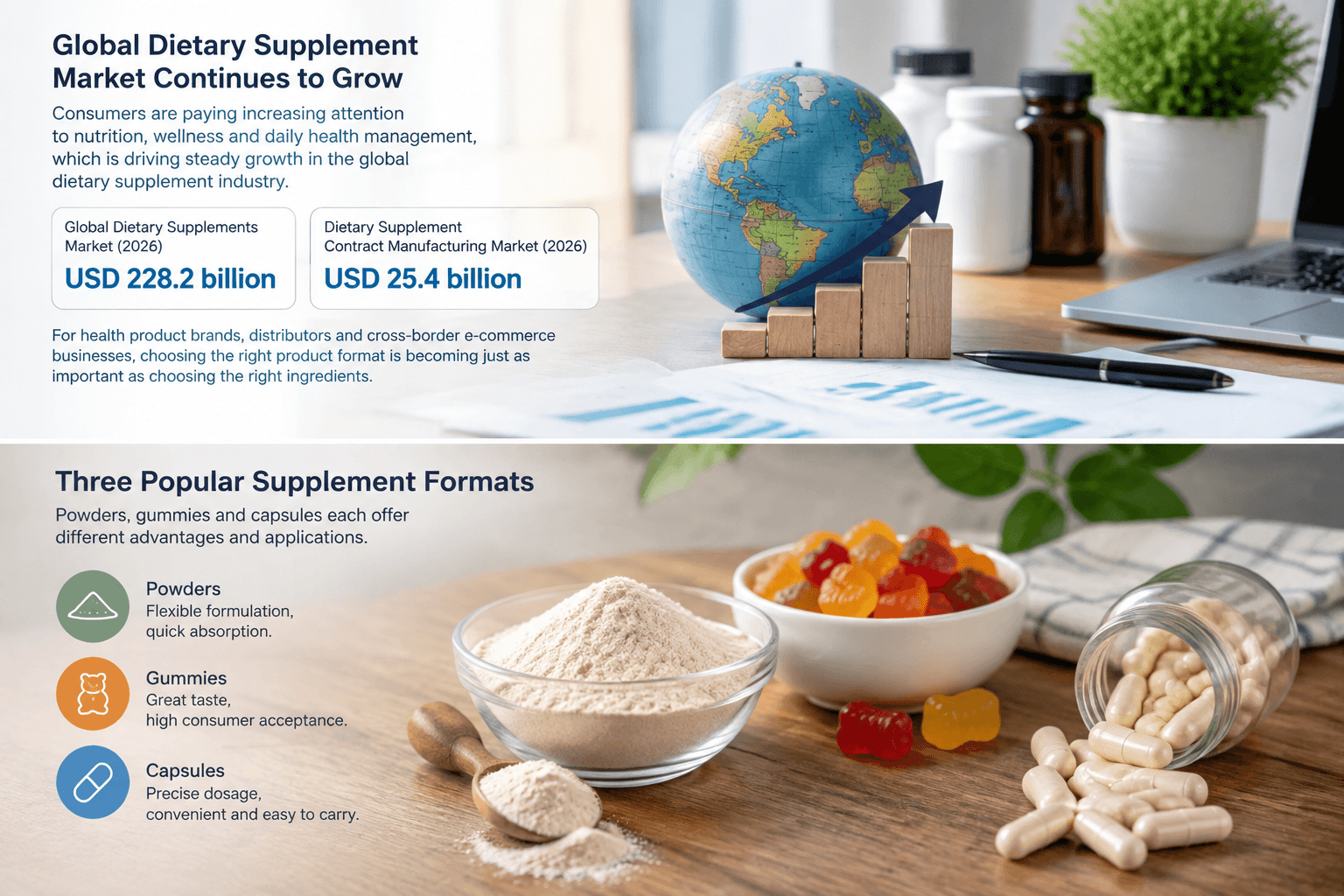
The global dietary supplement industry continues to develop as consumers pay increasing attention to nutrition, wellness and daily health management.
For health product brands, distributors and cross-border e-commerce businesses, choosing the right product format is becoming just as important as choosing the right ingredients. Formula flexibility, consumer experience, packaging, production capabilities and supply-chain support are all important considerations.
According to Grand View Research’s 2026 market data, the global dietary supplements market is estimated to reach approximately USD 228.2 billion in 2026, while the dietary supplement contract manufacturing market is estimated at approximately USD 25.4 billion. These figures reflect the growing importance of outsourced manufacturing and customized product development.
Among different supplement formats, powders, gummies and capsules each offer different advantages and applications.
1. Powder Supplements: Flexible Formulas and Customization
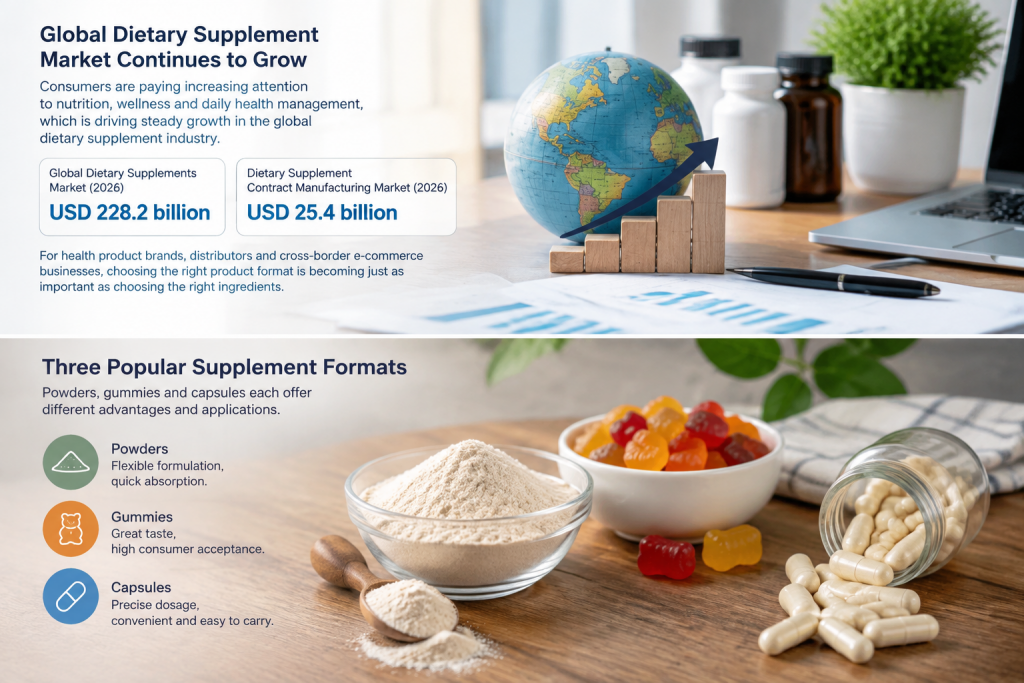
Powder is one of the most flexible formats in the dietary supplement industry.
Protein powder, collagen powder, dietary fiber powder, vitamin and mineral powder, probiotic powder and herbal extract powder can all be developed in powder form.
For brands, powders provide considerable flexibility in formula development. Ingredients, flavors, sweetness, colors and package sizes can often be customized according to market requirements.
Common packaging options include:
Single-serving sachets
Bottles and jars
Stick packs
Bulk powder packaging
Customized formulas and flavors
Powder supplements can be used in sports nutrition, daily nutrition, beauty products and functional nutrition products.
For new brands that want to test a product concept before expanding production, flexible powder customization can also provide a practical product-development option.
2. Gummy Supplements: Taste and Consumer Experience
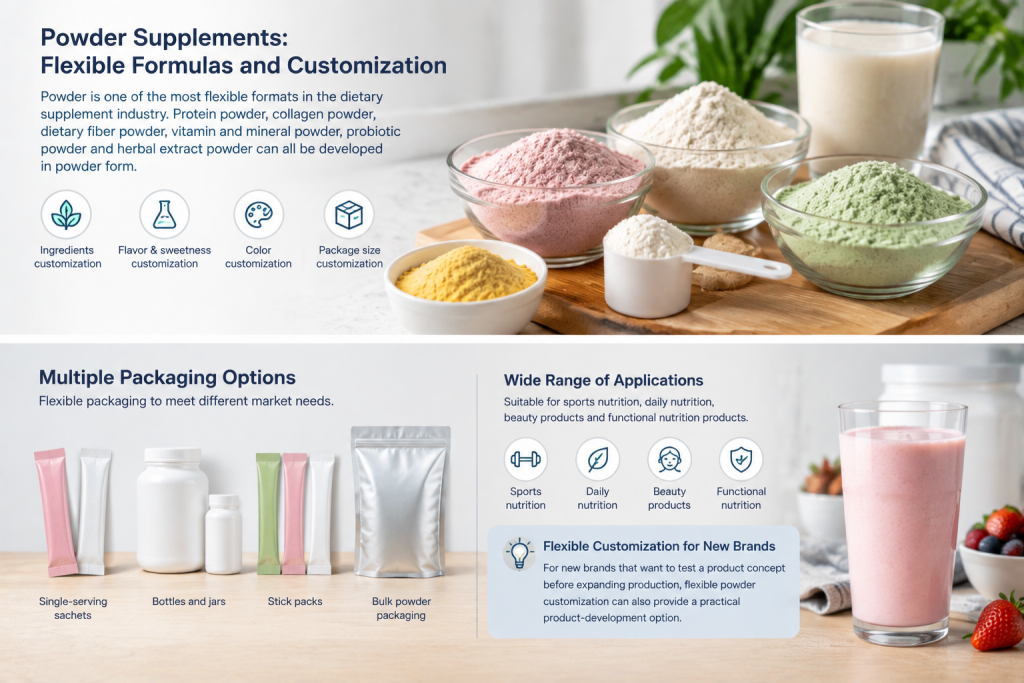
Gummies have become an increasingly visible format in the supplement market.
Compared with traditional capsules, gummies can provide a more food-like consumption experience. This makes them suitable for a variety of consumer segments and product concepts.
Common gummy products include vitamin gummies, mineral gummies, probiotic gummies, collagen gummies and botanical gummies.
For brands developing gummy supplements, several factors need to be considered:
Active ingredients
Nutrient dosage
Taste
Color
Shape
Sugar content
Packaging
Product stability
This means that an experienced OEM/ODM supplier can play an important role in moving a product idea from concept to finished product.
3. Capsules: Precise Dosage and Convenient Daily Use
Capsules remain a widely used supplement format.
They are commonly selected for products that require defined serving sizes, convenient transportation and simple daily consumption.
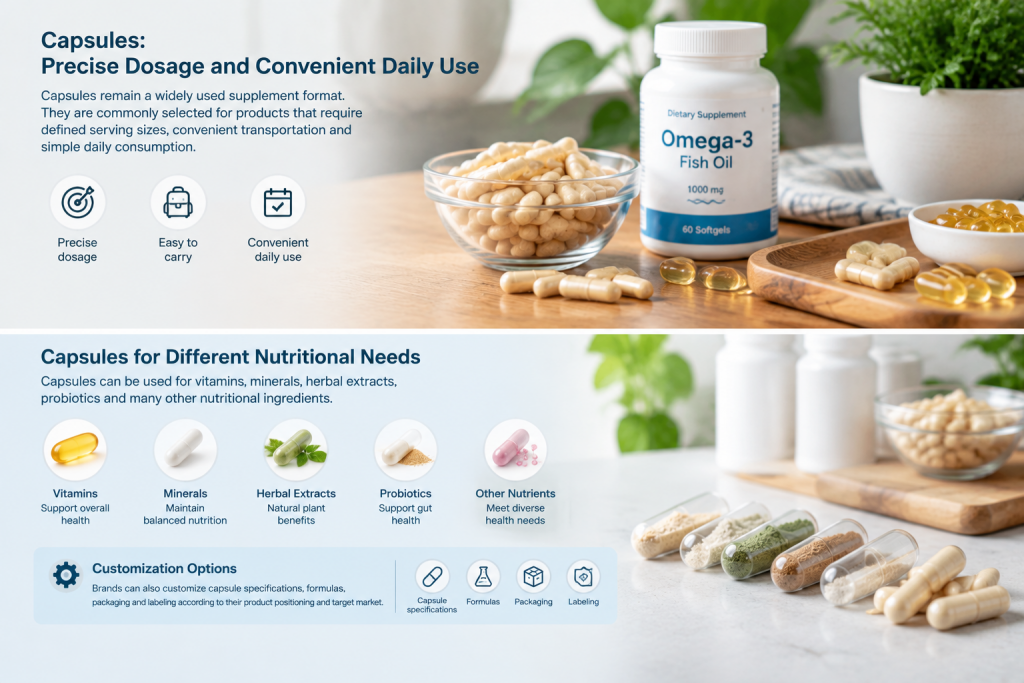
Capsules can be used for vitamins, minerals, herbal extracts, probiotics and many other nutritional ingredients.
Brands can also customize capsule specifications, formulas, packaging and labeling according to their product positioning and target market.
4. Why Are More Brands Considering OEM/ODM?
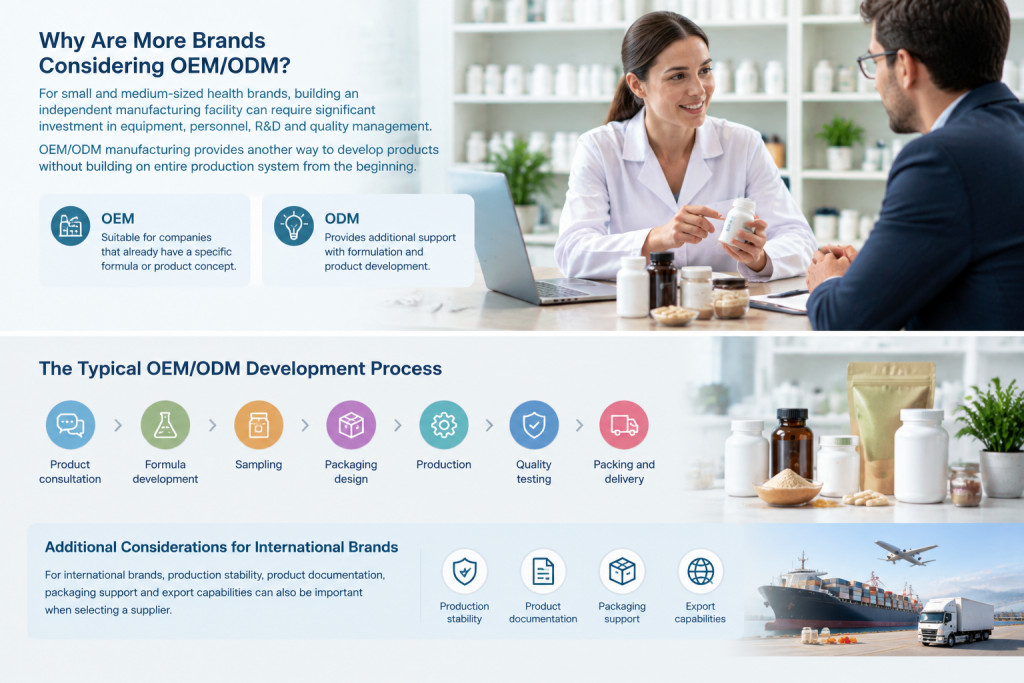
For small and medium-sized health brands, building an independent manufacturing facility can require significant investment in equipment, personnel, R&D and quality management.
OEM/ODM manufacturing provides another way to develop products without building an entire production system from the beginning.
OEM is often suitable for companies that already have a specific formula or product concept, while ODM can provide additional support with formulation and product development.
A typical development process may include:
Product consultation → Formula development → Sampling → Packaging design → Production → Quality testing → Packing and delivery
For international brands, production stability, product documentation, packaging support and export capabilities can also be important when selecting a supplier.
5. Quality and Regulatory Compliance Remain Essential
As the supplement market becomes more competitive, brands cannot focus only on product appearance and price.
Raw material quality, manufacturing processes, testing, labeling and market-specific regulations are also important.

For the U.S. market, the FDA has specific Current Good Manufacturing Practice requirements for dietary supplements. These requirements address areas such as production, packaging, quality control and manufacturing processes.
The FDA also requires dietary supplement labels to contain specific information, including the product identity, Supplement Facts, other ingredients, net quantity and manufacturer, packer or distributor information. Certain new dietary ingredients may also require premarket notification.
For this reason, brands should consider regulatory requirements at the beginning of product development rather than waiting until the manufacturing stage is complete.
6. From Manufacturing Supplier to Product Development Partner
The modern health-product supply chain is becoming more collaborative.
Many brands now expect suppliers to provide support beyond simple manufacturing, including formula development, dosage-form selection, packaging and international supply-chain services.
For powder, gummy and capsule products, an OEM/ODM supplier can help brands select a suitable format based on the target market, consumer group, sales channel and budget.
For example:
Powders can be suitable for products that emphasize formula flexibility and multiple consumption options.
Gummies can be suitable for products that emphasize taste and consumer experience.
Capsules can be suitable for products that emphasize defined dosage and portability.


The right choice ultimately depends on the formula, target consumers, regulations, sales channel and overall product cost.
Conclusion
The dietary supplement industry continues to move toward greater product diversity, customization and professional supply-chain services.
Powders, gummies and capsules each have their own characteristics, while OEM/ODM manufacturing provides a flexible approach for brands developing new health products.
For brands, wholesalers and cross-border e-commerce businesses looking for a reliable health-product supplier, a partner capable of supporting formulation, product customization, packaging, manufacturing and international trade can help simplify the overall product-development process.