The Complete Guide to Capsules: Sizes, Materials, and Red Flags
August 12, 2026Product News
Question:
Have you ever noticed that capsules come in different sizes? Sometimes you get a big, chunky one, and other times a tiny little one. Does size matter? Or is it just to make it easier to swallow?
Also, when you look at the shell – is it made of animal gelatin? Or plant-based materials? And the big question: why do we even need this shell?
Today, we are going to do a complete deep dive into capsules. We’ll cover five critical dimensions: Sizes & Capacity, Shell Materials (Gelatin vs. Vegetarian), Why Encapsulate, and the absolute Red Flags you must remember. Let’s get started!
Answer:
Part 1: Sizes & Capacity
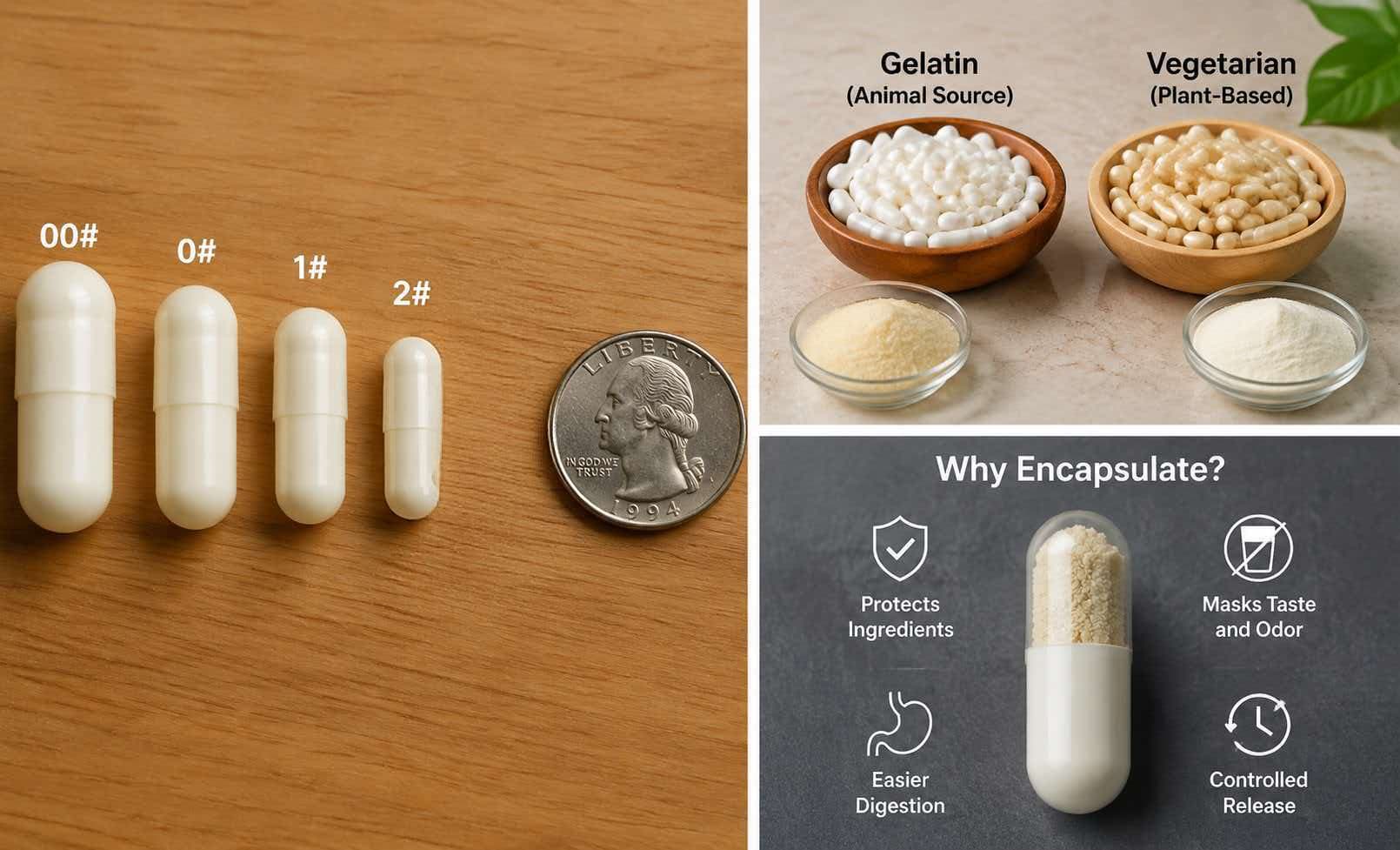
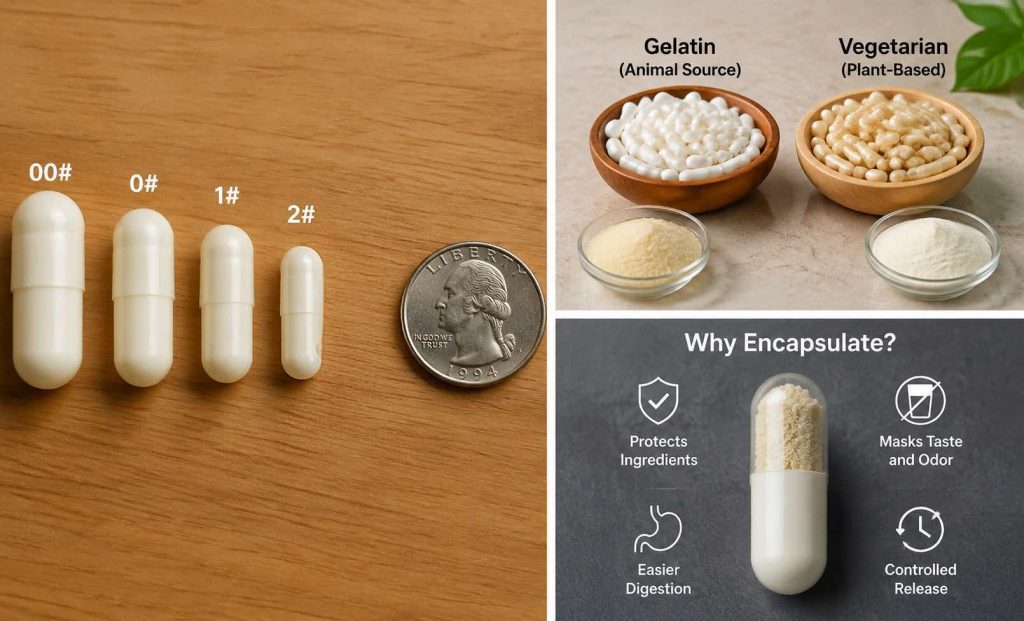
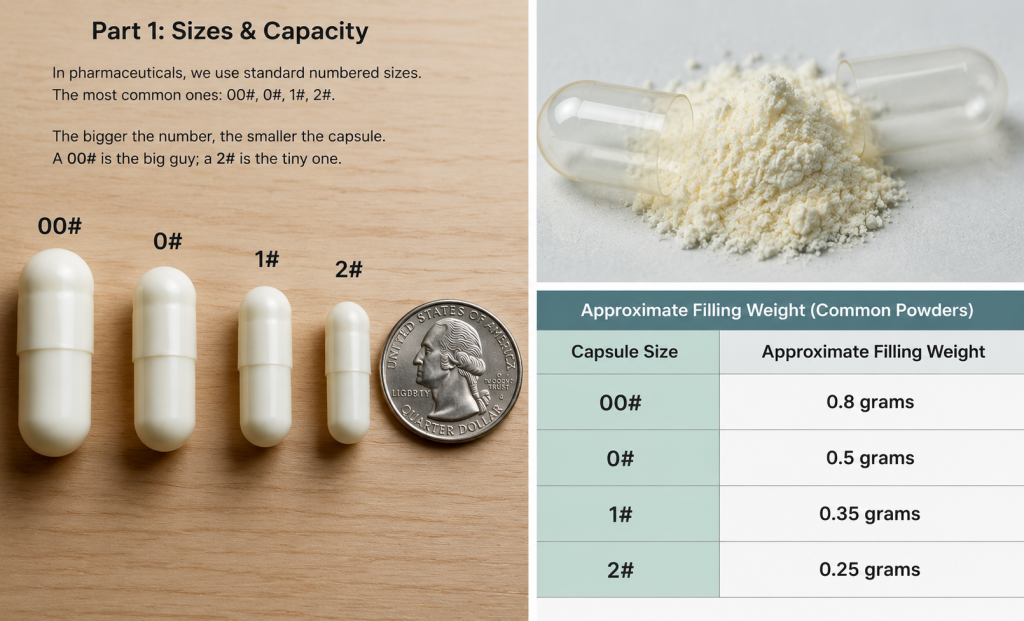
Let’s start with the most visual dimension: size. In pharmaceuticals, we use standard numbered sizes. The most common ones you’ll see are 00#, 0#, 1#, 2#.
To give you a sense of scale – the bigger the number, the smaller the capsule. A 00# is the big guy; a 2# is the tiny one.
Now, what does that mean in terms of actual capacity? Here’s the approximate filling weight for reference (assuming the density of common powders):
00# can hold about 0.8 grams – this is your heavy-duty capsule, often used for antibiotics or high-dose herbal extracts.
0# holds about 0.5 grams – very common for many prescription drugs.
1# holds about 0.35 grams.
2# holds about 0.25 grams.
So, size isn’t random! It’s precisely matched to the dose required. A 00# doesn’t mean “stronger” – it just means it needs more physical space to hold that specific amount of powder.
Part 2: The Shell Origin – Gelatin vs. Vegetarian Capsules
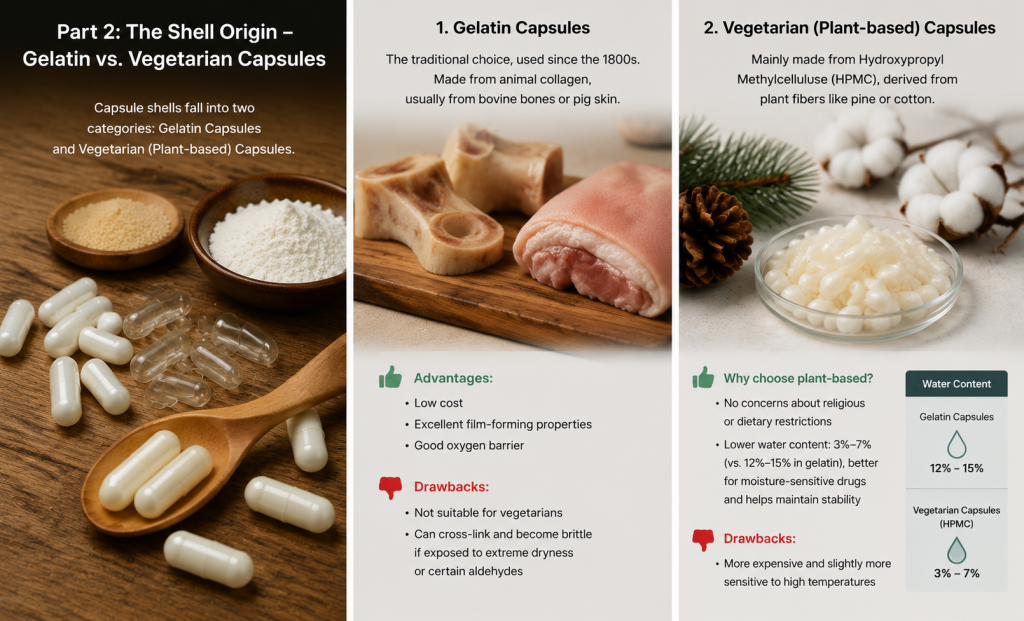
Moving on to the shell itself. Generally speaking, capsule shells fall into two categories: Gelatin Capsules and Vegetarian (or Plant-based) Capsules.
First, Gelatin Capsules – this is the traditional one, used since the 1800s. It’s made from animal collagen, usually from bovine bones or pig skin.
Its advantages: low cost, excellent film-forming properties, and good oxygen barrier. However, the drawbacks are obvious – it’s not suitable for vegetarians, and it can cross-link and become brittle if exposed to extreme dryness or certain aldehydes.
On the other hand, we have Vegetarian Capsules, mainly made from Hydroxypropyl Methylcellulose (HPMC) , which is derived from plant fibers like pine or cotton.
Why choose plant-based? First, it has no concerns about religious or dietary restrictions. Second, it has lower water content – usually only 3% to 7%, compared to 12% to 15% in gelatin. This makes it a better choice for moisture-sensitive drugs, as it helps maintain stability. The downside? It’s more expensive and slightly more sensitive to high temperatures.
Part 3: Why make it into capsules?
Now, the fundamental question – why bother putting the prow into this shell? We summarize it into three core purposes:
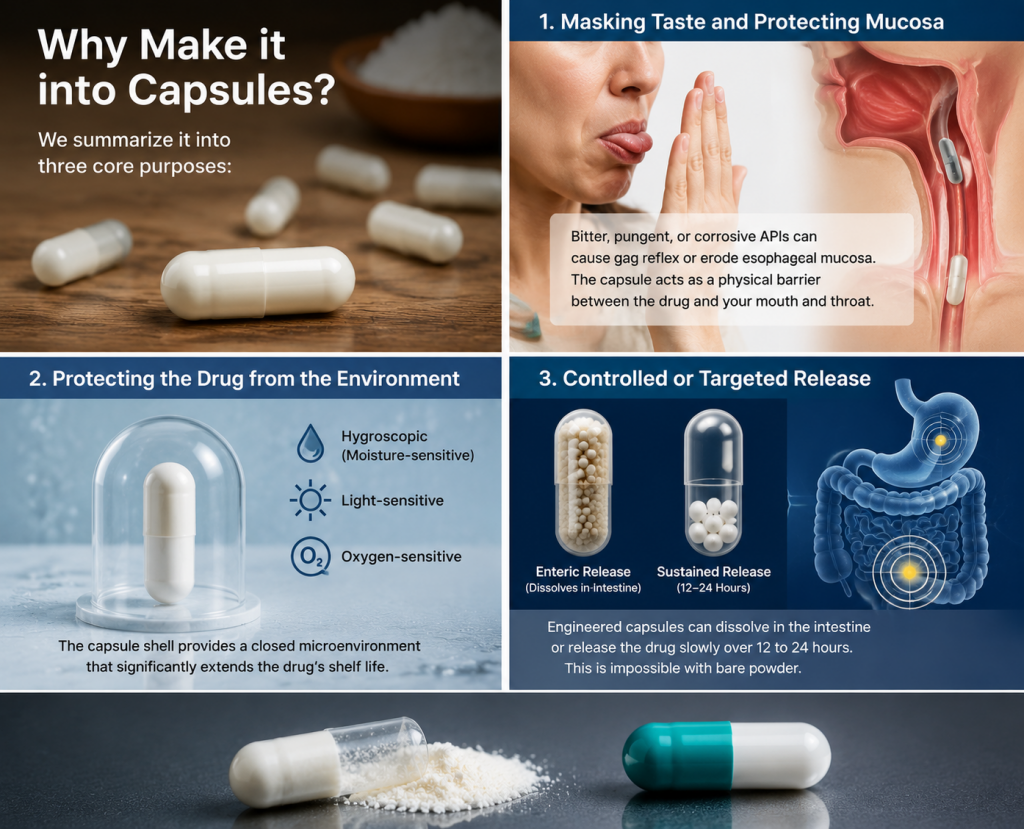
Purpose No. 1 – Masking Taste and Protecting Mucosa.
Many active pharmaceutical ingredients are extremely bitter, pungent, or corrosive. If you take them as bare powder, your taste buds will immediately trigger a gag reflex. Worse, drugs like certain antibiotics or NSAIDs can directly erode the esophageal mucosa. The capsule is the physical barrier that separates the drug from your mouth and throat.
Purpose No. 2 – Protecting the Drug from the Environment.
Some drugs are highly hygroscopic – they absorb moisture from the air and degrade quickly. Some are light-sensitive or oxygen-sensitive. The capsule shell provides a closed microenvironment that significantly extends the drug’s shelf life.
Purpose No. 3 – Controlled or Targeted Release.
This is the advanced application. Through special shell materials or the micro-pellets inside, capsules can be engineered to either dissolve in the intestine instead of the stomach, or release the drug slowly over 12 to 24 hours. This is impossible with bare powder.
Summary:
Today we covered: Sizes (from 00# to 2# and their capacities), Materials (gelatin vs. vegetarian), the three reasons for encapsulation.
Hope the basic information about these capsules is helpful to you.